The Physics of Sound:
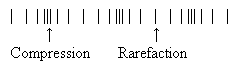
Sound is a mechanical wave created by a vibrating object and travels through a medium. A median is what a wave travels through, for example air, water, or earth. Sound travels in a longitudinal wave which is comprised of compressions and rarefactions.
A compression is an area of high pressure, while a rarefaction is an area of low pressure. A sound wave also carries energy at a specific frequency. The energy of the wave is related to the loudness or amplitude of the sound wave. The more energy the sound wave has, the louder the sound is perceived. The intensity of a sound wave is loudness

The intensity of a wave will dissipate the further away from the source. This is due to the fact that the wave is spreading out as it travels, thus occupying more area. There is an inverse square relationship between intensity and distance.
The frequency of a sound wave is related to the pitch of the sound and is measured in Hertz (Hz). The frequency of a wave is how quickly the wave oscillates between compressions and rarefactions. The higher the frequency, the faster the object vibrates, the higher the pitch. The lower the frequency, the slower the object vibrates, the lower the pitch.
| Hearing Range: | |
| Humans | 20 Hz to 20 kHz |
| Dogs | 50 Hz to 45 kHz |
| Cats | 45 Hz to 85 kHz |
| Bats | Up to 120,000 kHz |
| Dolphins | Up to 200,000 kHz |
| Elephants | 5 Hz to 10 kHz |